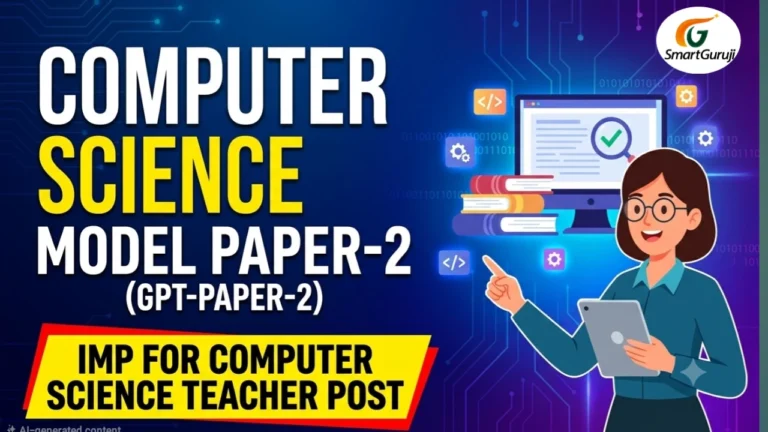
Decoding the Syllabus: How to Prepare for the GPT Paper-2 Computer Science Teacher Exam
Are you gearing up for the Computer Science Teacher Exam? Navigating a broad syllabus can feel like decoding a complex algorithm, but breaking it down into manageable modules is the key to success. The official syllabus for GPT Paper-2 (Computer Science Teachers) spans ten comprehensive units, blending foundational theories with cutting-edge technologies.
Here is a strategic breakdown of what you need to master.
Core Foundations and Hardware
Building a strong baseline is essential. The syllabus kicks off with the basics and scales up to complex hardware architectures.
- Fundamentals & Architecture: Expect topics ranging from the evolution of computers and motherboard assembling to digital logic circuits, instruction cycles, and memory hierarchy.
- Mathematical Logic: You must be comfortable with propositional logic, graph theory, Bayes’ Theorem, and Boolean algebra.
- Data Structures & Algorithms: Prepare to analyze time and space complexities, along with data structures like trees, AVL trees, graphs, and algorithms such as Breadth-First and Depth-First Search.
Software, Programming, and Systems
A significant portion of the exam tests your ability to design, write, and manage software systems.
- Programming Languages: The curriculum requires proficiency in C, C++ (Object-Oriented Programming), and Web Programming encompassing HTML, DHTML, CSS, XML, Scripting, and JavaScript.
- Databases & Operating Systems: You will be tested on DBMS architecture, SQL, normalization, along with OS concepts like process scheduling, deadlocks, and Linux/Windows design principles.
- Software Engineering: Understand software process models (including Agile and Scrum), requirements modeling, and various testing methodologies like White-box and Black-box testing.
Networking and Emerging Technologies
The exam expects future teachers to be well-versed in connected and intelligent systems.
- Computer Networks: Key areas include the OSI and TCP/IP models, IPv4/IPv6 address space, Network Security (Cryptography), and mobile technologies (GSM, CDMA).
- Advanced Tech: Get ready to tackle Cloud Computing (SaaS, PaaS, IaaS), IoT basics, and Artificial Intelligence, including heuristic search, Natural Language Processing, and Artificial Neural Networks.
By organizing your study plan around these thematic blocks, you can tackle the extensive reference material effectively.
Complete List of Syllabus Units
Ensure you cover all ten official units outlined in the examination syllabus:
- Unit-1: Fundamentals of Computers
- Unit-2: Discrete Structures and Optimization
- Unit-3: Computer System Architecture
- Unit-4: Programming Languages and Computer Graphics
- Unit-5: Database Management Systems
- Unit-6: System Software and Operating system
- Unit-7: Software Engineering
- Unit-8: Data Structures and Algorithms
- Unit-9: Data Communication and Computer Networks
- Unit-10: Artificial Intelligence (AI)
Official Reference Books
The syllabus recommends the following textbooks for thorough preparation:
- Fundamentals of Computers, P.K.Sinha& p.Sinha, 2007, BPB Publishers.
- Introduction to the Design and Analysis of Algorithms, Anany Levitin: 2nd Edition, 2009, Pearson.
- Ian Somerville, “Software Engineering” 8th Edition, Pearson Education, 2009
- Roger S. Pressman, “A Practitioners Approach”, 7th Edition, McGraw-Hill, 2007.
- Rajkumar Buyya, Christian Vecchiola, S. ThamaraiSelvi: “Mastering Cloud Computing- Foundations and Applications Programming”, Elsevier, 2013
- Stuart Russel, Peter Norvig: Artificial Intelligence A Modern Approach, 2nd Edition, Pearson Education, 2003
- Tom Mitchell, “Machine Learning”, 1st Edition, McGraw-Hill,2017
- Fundamentals of Database Systems, Ramez Elamassri, Shankant B. Navathe, 7th Edition, Pearson, 2015
- An Introduction to Database Systems, Bipin Desai, Galgotia Publications, 2010.
- Ellis Horowitz and Sartaj Sahni, Fundamentals of Data Structures in C, 2nd Ed, Universities Press, 2014.
- Seymour Lipschutz, Data Structures Schaum’s Outlines, Revised 1st Ed, McGraw Hill, 2014.
- Hakima Chaouchi, “The Internet of Things Connecting Objects to the Web” ISBN: 978- 1-84821-140-7, Wiley Publications
- Computer Networks — Andrew S Tanenbaum, David. j. Wetherall, 5th Edition. Pearson Education/PHI.
- Data Communications and Networking – Behrouz A. Forouzan. Third Edition TMH.
- Pradeep K. Sinha and Priti Sinha: Computer Fundamentals (Sixth Edition), BPB Publication.
- Raj Kamal, “Internet and Web Technologies”, Mc GrawHill Education, 2007.
- Microsoft Office 2000, Michael Busby, Russell A. Stultz, BPB Publication.
- Google Apps for Dummies Paperback by Ryan Teeter, Karl Barksdale.
- Discrete Mathematics and Its Applications, Kenneth H. Rosen: seventh Edition.
- Ellis Horowitz and Sartaj Sahni: Fundamentals of Data Structures